
Choosing a kayak paddle size can seem simple until you start looking at different lengths. Paddles are usually measured in centimeters, and the difference between two sizes may only be 5 or 10 cm. Still, that small difference can change how your kayak feels on the water.
A paddle that is too short may force you to reach awkwardly around the sides of the kayak. A paddle that is too long can feel heavy, make your stroke less efficient, and put unnecessary strain on your arms and shoulders.
The good news is that finding the right size does not have to be complicated. The main things to consider are your height, your kayak’s width, and the way you paddle.
Key Takeaways
- Paddle length depends mainly on your height and kayak width, so both should be considered when choosing a size.
- Low-angle paddling usually works better with longer paddles, while high-angle paddling often suits shorter paddles.
- A paddle that is too short or too long can make paddling uncomfortable and lead to unnecessary fatigue.
- Seat height, blade size, and paddling style can also affect which paddle length feels right.
- When between sizes, check the manufacturer’s sizing chart and test the paddle if possible before making a final choice.
What Size Kayak Paddle Do You Need?
For most recreational and touring kayaks, paddle length is usually somewhere between 210 cm and 250 cm. The right size depends mainly on your height and the width of your kayak.
As a general starting point:
| Paddler Height | Narrow Kayak | Medium Kayak | Wide Kayak |
| Under 5′ | 210 cm | 220 cm | 230 to 240 cm |
| 5′ to 5’6″ | 215 cm | 220 cm | 230 to 240 cm |
| 5’6″ to 6′ | 220 cm | 220 to 230 cm | 230 to 250 cm |
| Over 6′ | 220 to 230 cm | 230 to 240 cm | 240 to 250+ cm |
This is a starting guide rather than a universal rule. Paddle manufacturers may use slightly different sizing charts, so it is worth checking the chart for the specific paddle you are considering.
Read: [What Is Kayaking?]
Why Does Kayak Width Matter?
Kayak width is one of the easiest things to overlook when choosing a paddle.
The wider your kayak, the farther the paddle blades have to reach from your hands to the water. A wider recreational or fishing kayak can therefore require a longer paddle than a narrow touring kayak, even when two paddlers are the same height.
For example, imagine two people who are both 5’8″. One uses a 23-inch-wide touring kayak, while the other uses a 32-inch-wide recreational kayak. They may need different paddle lengths because their hands are positioned differently relative to the water.
This is why choosing a paddle based only on your height can lead to the wrong size.
How Do You Measure Your Kayak Width?
You generally need the kayak’s width at its widest point or the width specified by the manufacturer.
If you already own the kayak, check its specifications first. If the information is not available, measure across the widest part of the kayak.
For many common kayaks, approximate widths fall into these ranges:
| Kayak Type | Typical Width |
| Performance kayak | 19 to 22 inches |
| Touring kayak | 22 to 25 inches |
| Recreational kayak | 26 to 30 inches |
| Wide recreational kayak | 30+ inches |
| Fishing kayak | Often 30+ inches |
These are general categories, not fixed measurements. Individual kayak models can be narrower or wider.
Low-Angle vs. High-Angle Paddling
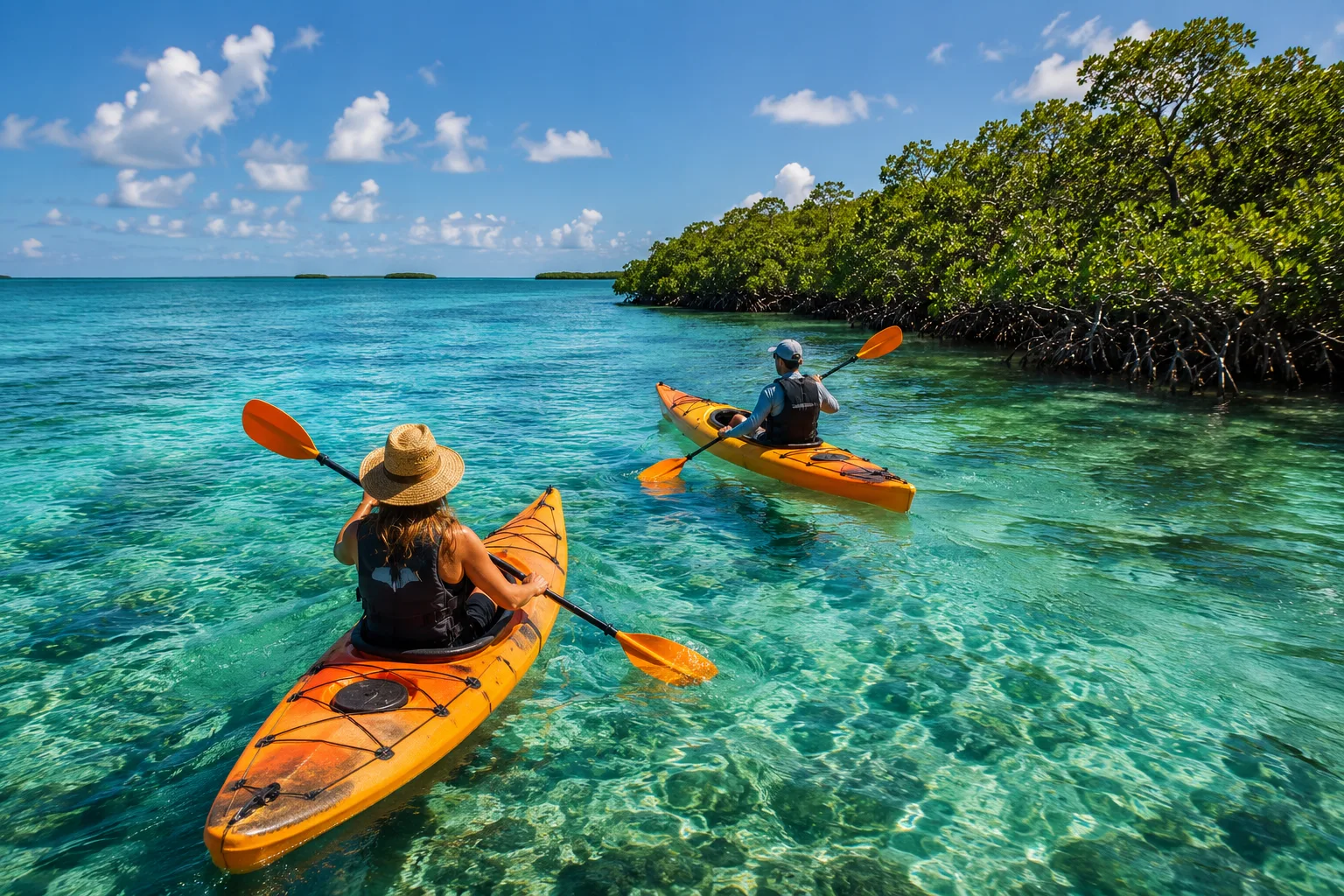
Your paddling style can change the paddle length you need.
There are two common forward-stroke styles: low-angle and high-angle paddling.
Low-Angle Paddling
With a low-angle stroke, the paddle travels through the water at a more relaxed angle. Your hands remain relatively low, and the blade is farther away from vertical.
This style is common for recreational kayaking, relaxed touring, and longer trips where a comfortable, steady rhythm is more important than maximum power.
Low-angle paddlers generally use a longer paddle with a narrower blade.
High-Angle Paddling
A high-angle stroke keeps the paddle more upright as it enters the water.
This style is more aggressive and can provide stronger strokes and quicker changes in direction. It is common among paddlers who want a faster cadence or more control.
High-angle paddles are generally shorter and have wider blades than low-angle paddles.
If you move from a relaxed low-angle style to a more upright high-angle stroke, you may find that a shorter paddle works better.
Kayak Paddle Length Chart
The following chart provides a useful starting point for recreational and touring kayaks using a relatively relaxed paddling style:
| Paddler Height | Kayak Under 24″ | Kayak 24 to 28″ | Kayak 29 to 33″ | Kayak Over 33″ |
| Under 5′ | 210 cm | 220 cm | 230 cm | 240 cm |
| 5′ to 5’6″ | 215 cm | 220 cm | 230 cm | 240 cm |
| 5’6″ to 6′ | 220 cm | 220 cm | 230 cm | 250 cm |
| Over 6′ | 220 cm | 230 cm | 240 cm | 250 cm |
This chart should be treated as a starting point. Manufacturer recommendations can vary, and factors such as your stroke, seat height, and kayak shape can influence the final choice.
What If You Are Between Two Paddle Sizes?
Being between two recommended sizes is common.
For example, your measurements might suggest either 220 cm or 230 cm. In that situation, consider how you normally paddle.
A shorter paddle can make sense if you use a more active, upright stroke. A longer paddle may be more comfortable if you use a relaxed stroke, have a wider boat, or sit relatively high.
REI notes that paddlers between sizes will often do well with the shorter option, although body proportions and paddling style can change that choice.
An adjustable paddle can also be useful when you are unsure because it allows you to make smaller changes to the length.
Read: [Kayak Vs Canoe]
Does Your Seat Height Matter?
Yes.
Your seat position changes how high your hands sit above the water. A higher seat can increase the distance your paddle needs to reach, while a lower seating position can reduce it.
This is especially relevant with fishing kayaks and some recreational kayaks that have elevated seats. Aqua Bound recommends considering seat height along with factors such as kayak width and paddling style when adjusting paddle length.
If your kayak has an unusually high seat, do not rely on a standard chart alone.
What Happens If Your Kayak Paddle Is Too Short?
A paddle that is too short can create several problems.
You may find yourself reaching farther out to get the blade into the water. Your hands may also come too close to the sides of the kayak during each stroke.
On a wide kayak, this can make your stroke feel cramped and uncomfortable. You may also compensate by changing your posture or raising your hands higher.
Over time, that can make paddling feel more tiring than it should.
What Happens If Your Kayak Paddle Is Too Long?
A paddle that is too long is not necessarily unusable, but it can make paddling less comfortable.
You may end up lifting more of the paddle during each stroke. The additional length can also increase the amount of effort needed to move the blade through the water.
A paddle that is significantly too long may make it harder to maintain a smooth, consistent stroke and can contribute to fatigue.
The goal is not simply to choose the longest paddle that reaches the water. It should allow you to paddle naturally.
Does Blade Size Affect Paddle Length?
Yes, but blade size and paddle length are separate choices.
A wider blade can move more water with each stroke and can provide more power. A narrower blade generally works well with a smoother, more efficient cadence.
Low-angle paddles commonly use longer, narrower blades, while high-angle paddles tend to use shorter, wider blades.
For long recreational trips, a lighter paddle with a blade that matches your natural cadence may feel better than a large, powerful blade.
For short, powerful strokes or quick acceleration, a larger blade may be more appropriate.
What Paddle Length Is Best for a Recreational Kayak?
Recreational kayaks tend to be wider than touring kayaks, so they often require longer paddles.
A recreational kayak may be around 26 to 30 inches wide, although individual models vary.
For many recreational paddlers, a paddle around 220 to 240 cm can be a reasonable starting range, but your height and paddling style still matter.
A taller person in a wide recreational kayak may need something longer than a shorter paddler in the same boat.
What Paddle Length Is Best for a Touring Kayak?
Touring kayaks are generally narrower, so they often use shorter paddles than wide recreational boats.
A touring kayak commonly falls around 22 to 25 inches wide.
Many paddlers in touring kayaks use paddles in the 210 to 230 cm range, depending on their height, stroke style, and the exact width of the boat.
A low-angle touring paddle may be longer than a high-angle paddle used in the same kayak.
What Paddle Length Is Best for a Fishing Kayak?
Fishing kayaks are often wider than standard recreational kayaks, particularly models designed for stability.
That extra width can mean you need a longer paddle to comfortably reach the water.
Your seat height also matters. Some fishing kayaks have elevated seats, which can increase the distance between your hands and the water.
Because fishing kayaks vary considerably in width and design, measure the actual kayak rather than choosing a paddle based only on the fact that it is a fishing kayak.
What Paddle Length Is Best for a Tandem Kayak?
Tandem kayaks are generally wider than many single kayaks, so they may require longer paddles.
However, the correct length still depends on the specific boat and where you are sitting.
Kayak Academy notes that two-person sea kayaks commonly use paddles around 225 to 235 cm, depending on the kayak’s width and other factors.
If two people are paddling the same tandem kayak, using matching paddles can also make it easier to maintain a consistent rhythm.
What Paddle Length Is Best for a Whitewater Kayak?
Whitewater paddles are usually shorter than paddles used for recreational or touring kayaks.
This is partly because whitewater paddlers use a more upright stroke and need quick, powerful movements. Whitewater kayaks are also much shorter and have different designs from touring and recreational boats.
Typical whitewater paddle lengths are often around 188 to 204 cm, depending mainly on the paddler’s height and style.
Durability is also particularly important for whitewater paddles because the paddle can experience contact with rocks and other obstacles.
Does Paddle Material Affect Sizing?
The material does not normally change the basic length recommendation.
You still choose the length based on the kayak and paddler. However, material affects the paddle’s weight, stiffness, durability, and price.
For example, lighter materials can reduce the amount of weight you repeatedly lift during each stroke. This can matter on longer trips where thousands of strokes may be taken.
A lighter paddle is not automatically better for every paddler. The right choice depends on how and where you use your kayak.
Read: [Is Kayaking Good Exercise?]
What Is Feathering?
Feathering refers to the angle between the two blades of a kayak paddle.
With an unfeathered paddle, both blades sit in the same plane. With a feathered paddle, one blade is rotated relative to the other.
Many two-piece paddles allow the blade angle to be adjusted. Feathering can change how the paddle feels during the recovery part of the stroke and can also affect how the upper blade moves through the wind.
Feathering is mostly a matter of preference and technique rather than a reason to automatically choose a different paddle length.
How Can You Test Whether a Paddle Is the Right Size?
The best test is to use the paddle on the kayak whenever possible.
Pay attention to how easily the blade reaches the water and whether your hands remain in a comfortable position.
A properly sized paddle should allow you to take a natural stroke without constantly reaching too far outward or lifting your hands unnecessarily.
If possible, try more than one size. Aqua Bound recommends trying different paddle sizes and types before committing, particularly when you are unsure which option feels right.
Read: [How to Kayak in the Ocean?]
Common Kayak Paddle Sizing Mistakes
A few mistakes come up repeatedly when people choose their first paddle.
Choosing Based Only on Height
Height matters, but kayak width matters too. Ignoring the boat’s width can lead to a paddle that is too short or too long.
Ignoring Paddling Style
A high-angle paddler and a relaxed low-angle paddler may prefer different lengths even when using the same kayak.
Choosing a Paddle Because It “Looks Right”
A paddle can look perfectly reasonable while still being uncomfortable to use. Actual fit matters more than appearance.
Ignoring Seat Height
A raised seat changes your position relative to the water and may affect the length that feels comfortable.
Buying Without Checking the Manufacturer’s Chart
Sizing recommendations vary slightly between brands and paddle models. Checking the manufacturer’s specifications is a useful final step.
A Simple Way to Choose Your Paddle
If you want to keep the process simple, follow these steps:
Measure your height.
Know your height in feet and inches.
Check your kayak’s width.
Use the manufacturer’s specifications or measure the boat.
Decide how you paddle.
Think about whether your normal stroke is relaxed and low or more upright and aggressive.
Use a sizing chart.
Start with the recommended length for your height and kayak width.
Consider your seat height.
A higher seat may affect the length you find comfortable.
Check the manufacturer’s recommendations.
Use the specific chart for the paddle you are buying.
Try it if possible.
A short on-water test can tell you a lot about whether the paddle feels natural.
FAQs About Kayak Paddle Size
What happens if my kayak paddle is the wrong size?
A paddle that is too short or too long can make your stroke less comfortable and efficient. It may also cause unnecessary fatigue during longer trips.
Can two people use the same kayak paddle?
They can, but the paddle length should suit the person using it. An adjustable paddle can be useful when two paddlers of different heights share the same kayak.
Are adjustable kayak paddles worth buying?
They can be useful if you are still figuring out your preferred length, share equipment, or use different kayaks. They also make storage and transportation easier.
Should kayak paddle length be measured in centimeters?
Yes. Kayak paddles are commonly sized in centimeters, making it easier to compare lengths between different brands and models.
Does paddle length affect kayaking speed?
It can. A properly sized paddle allows you to maintain an efficient stroke, while an unsuitable length may make paddling less comfortable and effective.
Is a longer kayak paddle better for beginners?
Not necessarily. Beginners should choose a paddle that matches their height, kayak width, and paddling style rather than simply choosing the longest option.
Should children use adult kayak paddles?
Usually, children benefit from shorter and lighter paddles that match their size and strength. An adult paddle may be too long or heavy for comfortable use.
Can a kayak paddle be too heavy?
Yes. A heavy paddle can make repeated strokes more tiring, particularly during longer trips. Paddle weight is worth considering along with length.
Does kayak seat position affect paddle choice?
Yes. A higher or lower seating position changes the distance between your hands and the water, which can influence the paddle length that feels comfortable.
How do I know if my kayak paddle feels right?
The paddle should allow you to reach the water naturally without excessive stretching or lifting. Your strokes should feel controlled and comfortable on both sides of the kayak.
Conclusion
Choosing the right kayak paddle size comes down to a few practical measurements rather than guesswork. Your height and kayak width are the main starting points, while paddling style, seat height, and kayak design can help you fine-tune the choice.
For many recreational and touring kayaks, paddles fall somewhere around 210 to 250 cm, but there is no single length that works for everyone.
A wide kayak generally calls for a longer paddle, while a narrow kayak can often use a shorter one. Low-angle paddlers commonly prefer longer, narrower-bladed paddles, while high-angle paddlers often use shorter paddles with wider blades.
If you are between two sizes, consider your stroke style and boat width rather than automatically choosing the longer option. When possible, testing a couple of sizes on the actual kayak is one of the easiest ways to find what feels comfortable.
The right paddle should make each stroke feel controlled and natural. It should reach the water comfortably without forcing you to stretch, lift your hands, or work harder than necessary.